What is Les Chaumes et la Voierosse?
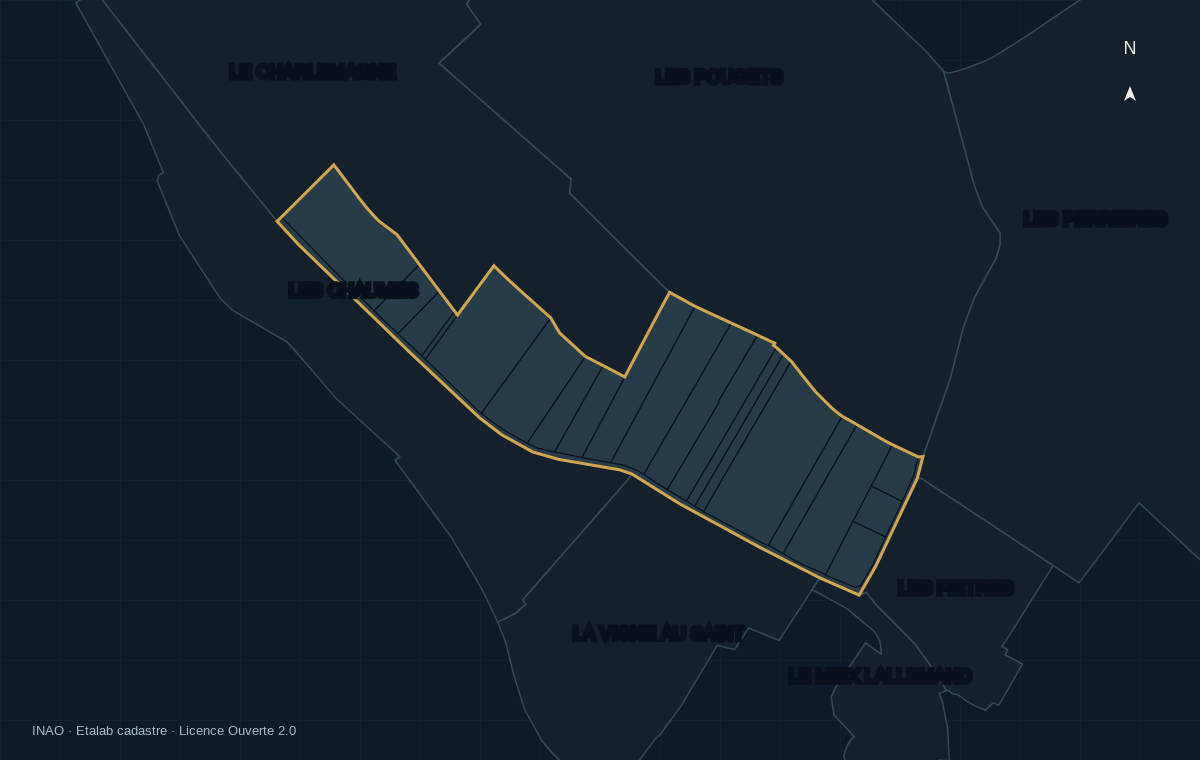
Les Chaumes et la Voierosse is a lieu-dit (a named place in the French land register) in Aloxe-Corton, Côte de Beaune, Burgundy. It is listed under Corton, a Grand Cru vineyard.
 Open the interactive atlas ↗
Lieu-dit · Burgundy
Lieu-dit · Corton · Grand Cru · Aloxe-Corton · Côte de Beaune
Key facts
Les Chaumes et la Voierosse is a lieu-dit (a named place in the French land register) in Aloxe-Corton, Côte de Beaune, Burgundy. It is listed under Corton, a Grand Cru vineyard.
Les Chaumes et la Voierosse is in Aloxe-Corton, Côte de Beaune, Burgundy.
The appellations listed in the public data are Corton-Charlemagne, Corton and Charlemagne.
Chardonnay is the main grape (Corton-Charlemagne). Pinot Blanc is also allowed in smaller amounts (Corton-Charlemagne). Chardonnay is the main grape for white wines (Corton). Pinot Blanc is also allowed in smaller amounts for white wines (Corton). Pinot Noir is the main grape for red wines (Corton). Chardonnay, Pinot Blanc and Pinot Gris are also allowed in smaller amounts for red wines (Corton). Chardonnay is the main grape (Charlemagne). Pinot Blanc is also allowed in smaller amounts (Charlemagne).
9 companies are listed in the public land register (2025): Hospices Civils de Beaune: 1.14 ha (29%); Groupement Foncier Viticole Marie Sordoillet: 0.55 ha (14%); Maurice Chapuis: 0.53 ha (13%); Soc Civ Domaine Héritiers Louis Jadot: 0.44 ha (11%); Domaine Robert Rapet: 0.4 ha (10%); SC Dom Hippolyte Thevenot Aloxe Corton: 0.24 ha (6.1%); GFA du Domaine Vincent Rapet: 0.2 ha (5.1%); GFA Domaine Chandon de Briailles: 0.12 ha (3%); GFV Chapuis: 0.08 ha (2%).
Les Chaumes et la Voierosse covers 4.16 ha on the map (about 10.27 acres).
20 cadastral parcels intersect the mapped outline of Les Chaumes et la Voierosse.
Les Chaumes et la Voierosse sits between 261 m and 272 m above sea level. It slopes gently (about 8%, or 5°) and faces south-southwest. The difference from bottom to top is about 11 m. About 1.5% of the mapped land slopes by less than 2°; 30% slopes by 5° or more. Around 90% of the mapped land slopes by 6.6° or less.
Les Chaumes et la Voierosse has an average elevation of 266 m. The mapped classified land in the Aloxe-Corton area averages 286 m. That puts Les Chaumes et la Voierosse about 20 m lower on average.
Les Chaumes et la Voierosse has an average slope of 4.5°. The mapped classified land in the Aloxe-Corton area averages 6.6°. Les Chaumes et la Voierosse is about 2.1° less steep on average.
The surface geology map lists marnes et calcaires à Digonelles, à Rhynchonelles, oolithiques, bioclastiques et à polypiers : dalle nacrée (89% of the mapped land); dépôts cryoclastiques de versants, parfois épais et à blocaille (12% of the mapped land). Source: BRGM / DREAL BFC harmonised geology 1:50,000 (Licence Ouverte 2.0).
The soil map lists Cônes de déjection du pied de Côte (100% of the mapped land). Source: INRAE / GIS Sol Carte des sols (RRP study 25021, Licence Ouverte 2.0).
The mapped outline of Les Chaumes et la Voierosse shares a boundary with LA VIGNE AU SAINT, LE CHARLEMAGNE, LE MEIX LALLEMAND, LES PERRIERES, LES POUGETS, LES FIETRES and LES CHAUMES.
Base yield: 48 hectolitres per hectare — Corton-Charlemagne. Maximum yield: 54 hectolitres per hectare — Corton-Charlemagne. Base yield: 48 hectolitres per hectare (white wines) — Corton. Maximum yield: 54 hectolitres per hectare (white wines) — Corton. Base yield: 42 hectolitres per hectare (red wines) — Corton. Maximum yield: 49 hectolitres per hectare (red wines) — Corton. Base yield: 48 hectolitres per hectare — Charlemagne. Maximum yield: 54 hectolitres per hectare — Charlemagne.
The grapes must provide at least 195 grams of sugar per litre of grape juice (Corton-Charlemagne). The minimum natural alcohol level is 12% by volume (Corton-Charlemagne). The grapes must provide at least 195 grams of sugar per litre of grape juice (white wines, Corton). The minimum natural alcohol level is 12% by volume (white wines, Corton). The grapes must provide at least 198 grams of sugar per litre of grape juice (red wines, Corton). The minimum natural alcohol level is 11.5% by volume (red wines, Corton). The grapes must provide at least 195 grams of sugar per litre of grape juice (Charlemagne). The minimum natural alcohol level is 12% by volume (Charlemagne).
After enrichment, total alcohol must not exceed 14.5% by volume (Corton-Charlemagne). After enrichment, total alcohol must not exceed 14.5% by volume (Corton). After enrichment, total alcohol must not exceed 14.5% by volume (Charlemagne).
The rules require ageing at least until 15 June in the year after harvest (Corton-Charlemagne). The rules require ageing at least until 15 June in the year after harvest (Corton). The rules require ageing at least until 15 June in the year after harvest (Charlemagne).
The rules allow sale to consumers from 30 June in the year after harvest (Corton-Charlemagne). The rules allow sale to consumers from 30 June in the year after harvest (Corton). The rules allow sale to consumers from 30 June in the year after harvest (Charlemagne).
2025: 477 mm of rain from April to September and 19 days at 30°C or more. 2024: 521 mm of rain from April to September and 9 days at 30°C or more. 2023: 345 mm of rain from April to September and 21 days at 30°C or more. Source: Météo-France model, nearest 8 km grid to Aloxe-Corton.
Elevation · slope · aspect
Les Chaumes et la Voierosse sits between 261 m and 272 m above sea level. It slopes gently (about 8%, or 5°) and faces south-southwest. Its neighbours include LA VIGNE AU SAINT, LE CHARLEMAGNE, LE MEIX LALLEMAND and LES PERRIERES.
Public land records
From the public land register, 2025. Private individuals are not named.
| Owner | Area | Share | Plots |
|---|---|---|---|
| Hospices Civils de BeauneHOSP | 1.14 ha | 29% | 4 |
| Groupement Foncier Viticole Marie SordoilletGFA | 0.55 ha | 14% | 1 |
| Maurice ChapuisSARL | 0.53 ha | 13% | 2 |
| Soc Civ Domaine Héritiers Louis JadotSCEA | 0.44 ha | 11% | 2 |
| Domaine Robert RapetGFA | 0.4 ha | 10% | 2 |
| SC Dom Hippolyte Thevenot Aloxe CortonSC | 0.24 ha | 6.1% | 1 |
| GFA du Domaine Vincent RapetGFA | 0.2 ha | 5.1% | 2 |
| GFA Domaine Chandon de BriaillesGFA | 0.12 ha | 3% | 1 |
| GFV ChapuisGFA | 0.08 ha | 2% | 1 |
From the official cahier des charges
| Rule | Value | Applies to | Source |
|---|---|---|---|
| Permitted varieties | chardonnay Bprincipal- cépage principal : chardonnay B ; | Corton-Charlemagne | Chapitre Ier, V, 1° · p. 72Edition 2011-11-04 |
| Permitted varieties | pinot blanc Baccessory- cépage accessoire : pinot blanc B. | Corton-Charlemagne | Chapitre Ier, V, 1° · p. 72Edition 2011-11-04 |
| Minimum planting density | 9,000 pieds/ha- Les vignes présentent une densité minimale à la plantation de | Corton-Charlemagne | Chapitre Ier, VI, 1° a) · p. 72Edition 2011-11-04 |
| Row spacing | ≤ 1.25 m- Les vignes présentent une densité minimale à la plantation de 9000 pieds par hectare, avec un écartement, | Corton-Charlemagne | Chapitre Ier, VI, 1° a) · p. 72Edition 2011-11-04 |
| Within-row vine spacing | ≥ 0.5 m- Les vignes présentent une densité minimale à la plantation de 9000 pieds par hectare, avec un écartement, entre les rangs, inférieur ou égal à 1,25 mètre, et un écartement, | Corton-Charlemagne | Chapitre Ier, VI, 1° a) · p. 72Edition 2011-11-04 |
| Within-row vine spacing | > 0.5 m- Les vignes peuvent être plantées en foule sous réserve de respecter la densité minimale à la plantation et un écartement, | Corton-Charlemagne | Chapitre Ier, VI, 1° a) · p. 72Edition 2011-11-04 |
| Minimum must sugar | 195 g/l de moût | Corton-Charlemagne | Chapitre Ier, VII, 2° · p. 73Edition 2011-11-04 |
| Minimum natural alcohol | 12 % vol. | Corton-Charlemagne | Chapitre Ier, VII, 2° · p. 73Edition 2011-11-04 |
| Base yield | 48 hl/ha | Corton-Charlemagne | Chapitre Ier, VIII, 1° · p. 73Edition 2011-11-04 |
| Maximum yield | 54 hl/ha | Corton-Charlemagne | Chapitre Ier, VIII, 2° · p. 74Edition 2011-11-04 |
| Maximum alcohol after enrichment | 14.5 % vol. | Corton-Charlemagne | Chapitre Ier, IX, 1° c) · p. 74Edition 2011-11-04 |
| Ageing until | 15 juin- Les vins font l'objet d'un élevage au moins jusqu'au 15 juin de l'année qui suit celle de la récolte ; | Corton-Charlemagne | Chapitre Ier, IX, 1° g) · p. 75Edition 2011-11-04 |
| Consumer release from | 30 juin4°- Dispositions relatives à la circulation des produits et à la mise en marché à destination du consommateur A l'issue de la période d'élevage, les vins sont mis en marché à destination du consommateur à partir du 30 juin de l'année qui suit celle de la récolte. | Corton-Charlemagne | Chapitre Ier, IX, 4° · p. 75Edition 2011-11-04 |
| Permitted varieties | chardonnay Bprincipal- cépage principal : chardonnay B ; | Corton · blanc | Chapitre Ier, V, 1° · p. 14Edition 2011-11-04 |
| Permitted varieties | pinot blanc Baccessory- cépage accessoire : pinot blanc B. | Corton · blanc | Chapitre Ier, V, 1° · p. 14Edition 2011-11-04 |
| Permitted varieties | pinot noir Nprincipal- cépage principal : pinot noir N ; | Corton · rouge | Chapitre Ier, V, 1° · p. 14Edition 2011-11-04 |
| Permitted varieties | chardonnay B, pinot blanc B, pinot gris Gaccessory- cépages accessoires : chardonnay B, pinot blanc B, pinot gris G. | Corton · rouge | Chapitre Ier, V, 1° · p. 14Edition 2011-11-04 |
| Accessory grape maximum | 15 %Leur proportion totale est limitée à 15 %b) - Vins rouges : Les cépages accessoires sont autorisés uniquement en mélange de plants dans les vignes. Leur proportion totale est limitée à 15 % au sein de chaque parcelle. | Corton · rouge | Chapitre Ier, V, 2° · p. 14Edition 2011-11-04 |
| Minimum planting density | 9,000 pieds/ha- Les vignes présentent une densité minimale à la plantation de | Corton | Chapitre Ier, VI, 1° a) · p. 15Edition 2011-11-04 |
| Row spacing | ≤ 1.25 m- Les vignes présentent une densité minimale à la plantation de 9000 pieds par hectare, avec un écartement, | Corton | Chapitre Ier, VI, 1° a) · p. 15Edition 2011-11-04 |
| Within-row vine spacing | ≥ 0.5 m- Les vignes présentent une densité minimale à la plantation de 9000 pieds par hectare, avec un écartement, entre les rangs, inférieur ou égal à 1,25 mètre, et un écartement, | Corton | Chapitre Ier, VI, 1° a) · p. 15Edition 2011-11-04 |
| Within-row vine spacing | > 0.5 m- Les vignes peuvent être plantées en foule sous réserve de respecter la densité minimale à la plantation et un écartement, | Corton | Chapitre Ier, VI, 1° a) · p. 15Edition 2011-11-04 |
| Minimum must sugar | 195 g/l de moût | Corton · blanc | Chapitre Ier, VII, 2° · p. 16Edition 2011-11-04 |
| Minimum natural alcohol | 12 % vol. | Corton · blanc | Chapitre Ier, VII, 2° · p. 16Edition 2011-11-04 |
| Minimum must sugar | 198 g/l de moût | Corton · rouge | Chapitre Ier, VII, 2° · p. 16Edition 2011-11-04 |
| Minimum natural alcohol | 11.5 % vol. | Corton · rouge | Chapitre Ier, VII, 2° · p. 16Edition 2011-11-04 |
| Base yield | 48 hl/ha | Corton · blanc | Chapitre Ier, VIII, 1° · p. 17Edition 2011-11-04 |
| Maximum yield | 54 hl/ha | Corton · blanc | Chapitre Ier, VIII, 1° · p. 17Edition 2011-11-04 |
| Base yield | 42 hl/ha | Corton · rouge | Chapitre Ier, VIII, 1° · p. 17Edition 2011-11-04 |
| Maximum yield | 49 hl/ha | Corton · rouge | Chapitre Ier, VIII, 1° · p. 17Edition 2011-11-04 |
| Maximum alcohol after enrichment | 14.5 % vol. | Corton | Chapitre Ier, IX, 1° d) · p. 18Edition 2011-11-04 |
| Ageing until | 15 juin- Les vins font l'objet d'un élevage au moins jusqu'au 15 juin de l'année qui suit celle de la récolte ; | Corton | Chapitre Ier, IX, 1° h) · p. 18Edition 2011-11-04 |
| Consumer release from | 30 juin4°- Dispositions relatives à la circulation des produits et à la mise en marché à destination du consommateur A l'issue de la période d'élevage, les vins sont mis en marché à destination du consommateur à partir du 30 juin de l'année qui suit celle de la récolte. | Corton | Chapitre Ier, IX, 4° · p. 19Edition 2011-11-04 |
| Permitted varieties | chardonnay Bprincipal- cépage principal : chardonnay B ; | Charlemagne | Chapitre Ier, V, 1° · p. 55Edition 2011-12-02 |
| Permitted varieties | pinot blanc Baccessory- cépage accessoire : pinot blanc B. | Charlemagne | Chapitre Ier, V, 1° · p. 55Edition 2011-12-02 |
| Minimum planting density | 9,000 pieds/ha- Les vignes présentent une densité minimale à la plantation de | Charlemagne | Chapitre Ier, VI, 1° a) · p. 55Edition 2011-12-02 |
| Row spacing | ≤ 1.25 m- Les vignes présentent une densité minimale à la plantation de 9000 pieds par hectare, avec un écartement, | Charlemagne | Chapitre Ier, VI, 1° a) · p. 55Edition 2011-12-02 |
| Within-row vine spacing | ≥ 0.5 m- Les vignes présentent une densité minimale à la plantation de 9000 pieds par hectare, avec un écartement, entre les rangs, inférieur ou égal à 1,25 mètre, et un écartement, | Charlemagne | Chapitre Ier, VI, 1° a) · p. 55Edition 2011-12-02 |
| Within-row vine spacing | > 0.5 m- Les vignes peuvent être plantées en foule sous réserve de respecter la densité minimale à la plantation et un écartement, | Charlemagne | Chapitre Ier, VI, 1° a) · p. 55Edition 2011-12-02 |
| Minimum must sugar | 195 g/l de moût | Charlemagne | Chapitre Ier, VII, 2° · p. 56Edition 2011-12-02 |
| Minimum natural alcohol | 12 % vol. | Charlemagne | Chapitre Ier, VII, 2° · p. 56Edition 2011-12-02 |
| Base yield | 48 hl/ha | Charlemagne | Chapitre Ier, VIII, 1° · p. 56Edition 2011-12-02 |
| Maximum yield | 54 hl/ha | Charlemagne | Chapitre Ier, VIII, 2° · p. 57Edition 2011-12-02 |
| Maximum alcohol after enrichment | 14.5 % vol. | Charlemagne | Chapitre Ier, IX, 1° c) · p. 57Edition 2011-12-02 |
| Ageing until | 15 juin- Les vins font l'objet d'un élevage au moins jusqu'au 15 juin de l'année qui suit celle de la récolte ; | Charlemagne | Chapitre Ier, IX, 1° g) · p. 58Edition 2011-12-02 |
| Consumer release from | 30 juin4°- Dispositions relatives à la circulation des produits et à la mise en marché à destination du consommateur A l'issue de la période d'élevage, les vins sont mis en marché à destination du consommateur à partir du 30 juin de l'année qui suit celle de la récolte. | Charlemagne | Chapitre Ier, IX, 4° · p. 58Edition 2011-12-02 |
Aloxe-Corton · Météo-France SIM/SAFRAN
Météo-France model, nearest 8 km grid. Rain and heat for April to September.
| Year | Rain, April–September | Days at 30°C or more | Rain, 1 September–10 October |
|---|---|---|---|
| 2025 | 476.6 mm | 19 | 142.9 mm |
| 2024 | 521.3 mm | 9 | 202.8 mm |
| 2023 | 345 mm | 21 | 60.5 mm |
Keep exploring
Sources & dates
Last updated .