What is Bas de Fourchaume?
Bas de Fourchaume is a lieu-dit (a named place in the French land register) in La Chapelle-Vaupelteigne, Chablis / Grand Auxerrois, Burgundy.
 Open the interactive atlas ↗
Lieu-dit · Burgundy
Lieu-dit · Chablis · Petit Chablis · La Chapelle-Vaupelteigne · Chablis / Grand Auxerrois
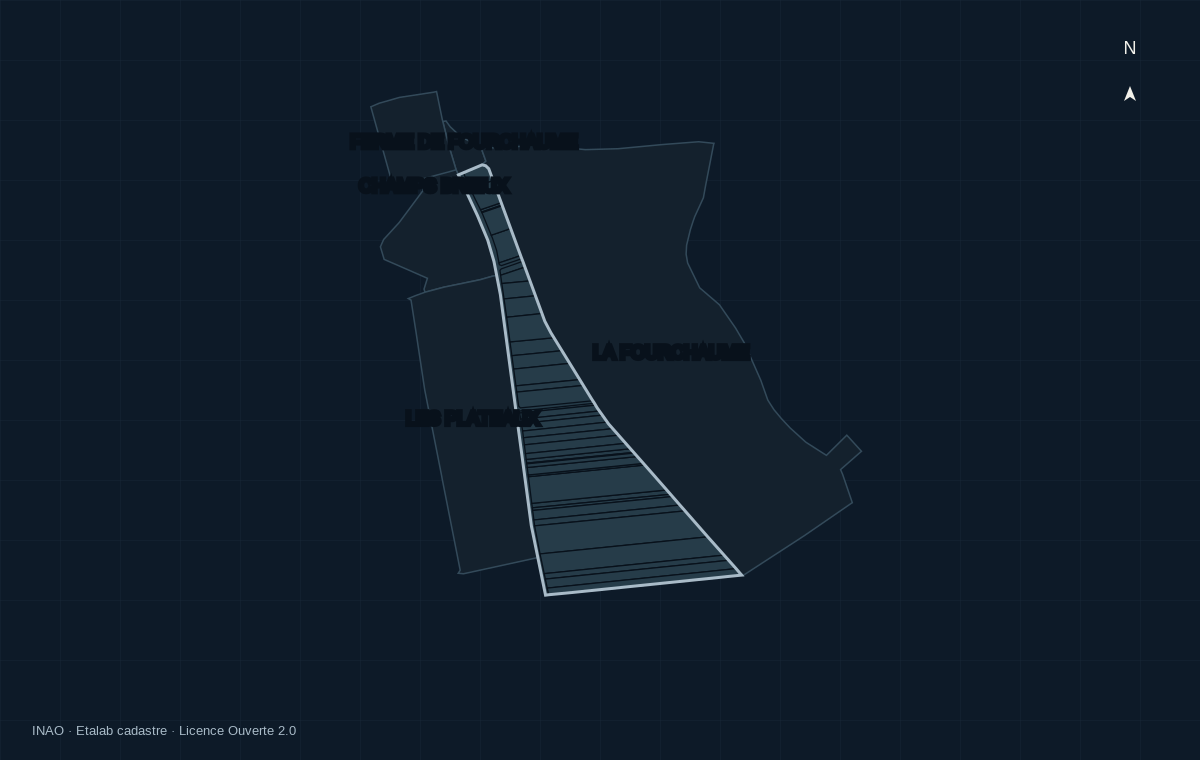
Key facts
Bas de Fourchaume is a lieu-dit (a named place in the French land register) in La Chapelle-Vaupelteigne, Chablis / Grand Auxerrois, Burgundy.
Bas de Fourchaume is in La Chapelle-Vaupelteigne, Chablis / Grand Auxerrois, Burgundy.
The appellations listed in the public data are Chablis and Petit Chablis.
Chardonnay is allowed (Chablis). Chardonnay is allowed (Petit Chablis).
3 companies are listed in the public land register (2025): GFA Lavigne: 3.09 ha (16%); Commune de la Chapelle Vaupelteigne: 0.68 ha (3.6%); GFA J J Carre: 0.2 ha (1%).
Bas de Fourchaume covers 20.21 ha on the map (about 49.93 acres).
41 cadastral parcels intersect the mapped outline of Bas de Fourchaume.
Bas de Fourchaume sits between 130 m and 158 m above sea level. It slopes gently (about 6%, or 3°) and faces west. The difference from bottom to top is about 28 m. About 3.4% of the mapped land slopes by less than 2°; 9% slopes by 5° or more. Around 90% of the mapped land slopes by 4.8° or less.
Bas de Fourchaume has an average elevation of 142 m. The mapped classified land in the Chablis area averages 217 m. That puts Bas de Fourchaume about 75 m lower on average.
Bas de Fourchaume has an average slope of 3.4°. The mapped classified land in the Chablis area averages 7°. Bas de Fourchaume is about 3.6° less steep on average.
The surface geology map lists Marnes et Calcaires à Exogyres (99% of the mapped land); Alluvions fluviatiles actuelles et récentes (actives ou stabilisées) indifférenciées, graviers, sables, argiles (Holocène) (1.1% of the mapped land). Source: BRGM / DREAL BFC harmonised geology 1:50,000 (Licence Ouverte 2.0).
The soil map lists Versants kimmeridgiens sur formations de pente argilo-caillouteuses en contrebas de la cuesta portlandienne (100% of the mapped land). Source: INRAE / GIS Sol Carte des sols (RRP study 25089, Licence Ouverte 2.0).
The mapped outline of Bas de Fourchaume shares a boundary with FERME DE FOURCHAUME, CHAMPS BRIEUX, LA FOURCHAUME and LES PLATEAUX.
At least 5,500 vines per hectare — Chablis. Base yield: 60 hectolitres per hectare — Chablis. Maximum yield: 75 hectolitres per hectare — Chablis. At least 5,500 vines per hectare — Petit Chablis. Base yield: 60 hectolitres per hectare — Petit Chablis. Maximum yield: 75 hectolitres per hectare — Petit Chablis.
The grapes must provide at least 161 grams of sugar per litre of grape juice (Chablis). The minimum natural alcohol level is 10% by volume (Chablis). The grapes must provide at least 153 grams of sugar per litre of grape juice (Petit Chablis). The minimum natural alcohol level is 9.5% by volume (Petit Chablis).
After enrichment, total alcohol must not exceed 13% by volume (Chablis). After enrichment, total alcohol must not exceed 12.5% by volume (Petit Chablis).
2025: 401 mm of rain from April to September and 22 days at 30°C or more. 2024: 578 mm of rain from April to September and 12 days at 30°C or more. 2023: 310 mm of rain from April to September and 21 days at 30°C or more. Source: Météo-France model, nearest 8 km grid to Chablis.
Elevation · slope · aspect
Bas de Fourchaume sits between 130 m and 158 m above sea level. It slopes gently (about 6%, or 3°) and faces west. Its neighbours include FERME DE FOURCHAUME, CHAMPS BRIEUX, LA FOURCHAUME and LES PLATEAUX.
Public land records
From the public land register, 2025. Private individuals are not named.
| Owner | Area | Share | Plots |
|---|---|---|---|
| GFA LavigneGFA | 3.09 ha | 16% | 2 |
| Commune de la Chapelle VaupelteigneCOM | 0.68 ha | 3.6% | 4 |
| GFA J J CarreAUPM | 0.2 ha | 1% | 1 |
From the official cahier des charges
| Rule | Value | Applies to | Source |
|---|---|---|---|
| Permitted varieties | chardonnay BexclusiveLes vins sont issus exclusivement du cépage chardonnay B. | Chablis | Chapitre Ier, V · p. 3Edition 2025-09-18 |
| Minimum planting density | 5,500 pieds/ha | Chablis | Chapitre Ier, VI, 1° a) · p. 3Edition 2025-09-18 |
| Row spacing | ≤ 1.2 m- Les vignes présentent une densité minimale à la plantation de 5500 pieds à l'hectare, avec un écartement moyen | Chablis | Chapitre Ier, VI, 1° a) · p. 3Edition 2025-09-18 |
| Row spacing | ≤ 1.6 mtion de 5500 pieds à l'hectare, avec un écartement moyen entre les rangs, inférieur ou égal à 1,20 mètre, à l'exception des vignes plantées sur des pentes supérieures ou égales à 40 % pour lesquelles | Chablis | Chapitre Ier, VI, 1° a) · p. 3Edition 2025-09-18 |
| Row spacing | ≤ 2 mre, à l'exception des vignes plantées sur des pentes supérieures ou égales à 40 % pour lesquelles cet écartement est inférieur ou égal à 1,60 mètre ; lorsque l'écartement est irrégulier, l'écartement | Chablis | Chapitre Ier, VI, 1° a) · p. 3Edition 2025-09-18 |
| Within-row vine spacing | ≥ 0.8 m- Les vignes présentent un écartement, | Chablis | Chapitre Ier, VI, 1° a) · p. 3Edition 2025-09-18 |
| Minimum must sugar | 161 g/l de moût | Chablis | Chapitre Ier, VII, 2° · p. 5Edition 2025-09-18 |
| Minimum natural alcohol | 10 % vol. | Chablis | Chapitre Ier, VII, 2° · p. 5Edition 2025-09-18 |
| Base yield | 60 hl/ha | Chablis | Chapitre Ier, VIII, 1° · p. 5Edition 2025-09-18 |
| Maximum yield | 75 hl/ha | Chablis | Chapitre Ier, VIII, 1° · p. 5Edition 2025-09-18 |
| Maximum alcohol after enrichment | 13 % vol. | Chablis | Chapitre Ier, IX, 1° b) · p. 6Edition 2025-09-18 |
| Permitted varieties | chardonnay BexclusiveLes vins sont issus exclusivement du cépage chardonnay B. | Petit Chablis | Chapitre Ier, V · p. 3Edition 2024-01-11 |
| Minimum planting density | 5,500 pieds/ha | Petit Chablis | Chapitre Ier, VI, 1° a) · p. 3Edition 2024-01-11 |
| Row spacing | ≤ 1.2 m- Les vignes présentent une densité minimale à la plantation de 5500 pieds à l'hectare, avec un écartement moyen | Petit Chablis | Chapitre Ier, VI, 1° a) · p. 3Edition 2024-01-11 |
| Row spacing | ≤ 1.6 mtion de 5500 pieds à l'hectare, avec un écartement moyen entre les rangs, inférieur ou égal à 1,20 mètre, à l'exception des vignes plantées sur des pentes supérieures ou égales à 40 % pour lesquelles | Petit Chablis | Chapitre Ier, VI, 1° a) · p. 3Edition 2024-01-11 |
| Row spacing | ≤ 2 m- Lorsque l'écartement est irrégulier, l'écartement | Petit Chablis | Chapitre Ier, VI, 1° a) · p. 3Edition 2024-01-11 |
| Within-row vine spacing | ≥ 0.8 m- Les vignes présentent un écartement, | Petit Chablis | Chapitre Ier, VI, 1° a) · p. 3Edition 2024-01-11 |
| Minimum must sugar | 153 g/l de moût | Petit Chablis | Chapitre Ier, VII, 2° · p. 4Edition 2024-01-11 |
| Minimum natural alcohol | 9.5 % vol. | Petit Chablis | Chapitre Ier, VII, 2° · p. 4Edition 2024-01-11 |
| Base yield | 60 hl/ha | Petit Chablis | Chapitre Ier, VIII, 1° · p. 4Edition 2024-01-11 |
| Maximum yield | 75 hl/ha | Petit Chablis | Chapitre Ier, VIII, 1° · p. 4Edition 2024-01-11 |
| Maximum alcohol after enrichment | 12.5 % vol. | Petit Chablis | Chapitre Ier, IX, 1° b) · p. 5Edition 2024-01-11 |
Chablis · Météo-France SIM/SAFRAN
Météo-France model, nearest 8 km grid. Rain and heat for April to September.
| Year | Rain, April–September | Days at 30°C or more | Rain, 1 September–10 October |
|---|---|---|---|
| 2025 | 400.7 mm | 22 | 127.5 mm |
| 2024 | 578.1 mm | 12 | 159.4 mm |
| 2023 | 310 mm | 21 | 38.2 mm |
Keep exploring
Sources & dates
Last updated .